The Moment's Trew Mullen Is About to Have Her Own Moment
Meet the breakout star of the film everyone is talking about.

The Moment, Charli XCX's entertaining Brat mockumentary from director Aidan Zamiri, is quite literally the moment. It was all anyone could talk about ahead of its premiere at the Sundance Film Festival last month, and fans lined up on the snowy streets of Park City to catch a glimpse of the stacked cast, including Charli XCX herself, Rosanna Arquette, Rachel Sennott, Alexander Skarsgård, and Kate Berlant. The buzz continued into the following week when frequent Charli collaborator A.G. Cook, who produced the film's soundtrack, released a video for the single "Residue" featuring a cameo from Kylie Jenner. Despite some early mixed reviews, distributor A24 announced the film is now its fastest-selling limited release ever. Love it or hate it, Charli's cultural influence continues to permeate the zeitgeist.
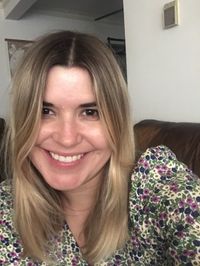
For newcomer Trew Mullen—who plays Ana, Charli's type A personal assistant in the film—the whole thing has been a whirlwind, to say the least. Even now, she's still trying to catch her breath and process it all. "This is all happening so fast," she tells us from her L.A. home. No stranger to working with female creative forces, the actress received the script for the film following her role in Zoë Kravitz's 2024 directorial debut Blink Twice and recalls loving how grounded and lived-in The Moment felt. Appropriately, the word "grounded" is one that comes up a lot during our conversation with Mullen, with the actress saying she felt a similar energy when meeting the pop star for the first time at the table read. But it's Mullen who feels particularly grounded at such a pivotal moment in her career.
With her sights set on a vibrant future full of emotional and complex performances, writing, and directing, Mullen is primed for her very own moment.

With this film in particular, there seems to be a fine line between reality and performance. What is appealing to you about this style of filmmaking?
They had a lot of room for improv, but we were also shooting so fast, so it was a "few takes and move on" kind of a thing. There wasn't too much wiggle room just because of that, but Aidan was very trusting in all of us to do what you want to do, which is so freeing as an actor. They shot it mostly handheld, so you didn't have to worry about eyelines or landing [on your mark]. I remember the first scene that we shot was in this garage, and I was walking and pacing. I asked the cinematographer, "Am I going too far out this way?" and he was like, "You can go wherever you want. I'll follow you." That is so freeing. Usually, it's like, "No, you need to lift your eyelines a little higher or face this way because of the light." It almost felt like doing a play. It lets you be in the world rather than you're depicting the world.
What can you tell us about your character Ana?
I play Ana, who is Charli's personal assistant, and she thrives on control. She's very private and very risk averse. She has a system of control, but it's built on sand. She knows that there's a danger in gossiping and a danger in sharing too much, so it's all very conscious and very on purpose that she keeps things very close to the chest.
How did you go about tapping into this character?
I work a lot with imagination, and so much of this character was very present tense language. I wasn't given a lot that was dictated about [her] past, but what I did gather from all the present tense language was a certain perspective and a worldview. With that, I created a history for where my character came from. It was a situation where she had to grow up very quickly and didn't really have the luxury to be playing around and had to become the adult and be very organized. There was also something about deciding to have a career in orbit to someone who is in the spotlight. It's like a chosen family in a way. Because you're spending so much time [with them] and have to give your whole self over, I found it interesting that Ana chooses that as a career path and what [she's] almost avoiding at home that this provides, which also makes it like a really big risk to lose.

What do you think the film is trying to say about the cost of fame?
I think it has a lot to do with autonomy or the lack of autonomy. I think it's about what happens when your work or your art becomes so successful that it's not really your own anymore, especially when you are your art. It just becomes so commercialized that you don't really own yourself anymore.
What is your own relationship with fame?
I feel a really bizarre dichotomy right now because I can be very reserved, and I can find myself to be a pretty private person. On the other hand, this career that I chose is very public. But for me, it's really about the internal vulnerability and being able to share that, which is private. I've said this before, but there's a quote that I think about a lot that says, "The space between your public and private self is where all the suffering lives." … You can still be a very reserved, private person, but the wider that space is—where your public self is something that's really far from and not true to your private self—it's a more painful experience. To keep those close together while also being able to be private where you want to be is important.
Charli is such a creative force who people really seem to gravitate toward. What stood out to you about her?
Public facing, she's extremely outgoing, and I mean, she still is all of those things—this loud, outgoing, very confident [person]—and the essence of her album is that. That is so much her, but then there's also this other part of her that I think is less of her brand that is just as much true. That is, that she's a person. The first time I met her was actually at the table read, and the table read was in this giant warehouse with a bunch of tables they smushed together to make one giant, long table. It was a little intimidating. They sat me right next to Charli, so that was the very first time I met her. There is something grounding about physically sitting next to someone and almost even not looking at each other but just feeling each other. It was calming in a way. I just felt this grounding, calming, and authentic energy from her, and that felt good. It was interesting to see how one chooses what to share and what part of themselves they make public.
On the topic of female creative forces, you also worked with Zoë Kravitz on her 2024 directorial debut Blink Twice. How did that experience shape you as a performer?
Working with Zoë, she is so sure of herself and has a very calming energy. She knows who she is, and she knows what she wants. I feel like I went on that set very excited and young, and I think the amount that I've grown since then feels astronomical. … I very much observed that side of her, and I was like, "What is that?" And I know that's in me too.
Something else I like to think about a lot is that we are all things. We're not just one thing, and I think it's important. It's very Carl Jung, expressing all different parts of yourself, and … the goal is to have them all be present, functioning at once. I think that [Zoë] taught me, probably even without realizing it, that that is a part of myself that I wanted to step into.

What would be your next dream project?
Anything that feels very internal and a complex woman that I can really sink my teeth into and where the writing allows for space and those things to be explored.
Is there a role like that you've seen in recent years that really inspires you?
That's a great question. There's something I saw recently, and it's just engraved in my brain. It's not necessarily new, but it's called Secret Sunshine. The female lead's emotional life is so large, and just the freedom to explore that and her willingness to, that's something I would love to be able to do.
I love your style. What's a look that makes you feel your most confident and powerful?
I love pieces that feel cinematic and almost like part of a story, and that doesn't need to be necessarily extravagant, but it makes me feel like a character. Fashion is interesting in that way because it allows you to put a shield on and choose a part of yourself that you want to represent, which is a true part of yourself. That's very different from acting, which is all about removing the layers of a shield and letting all the warts show. I used to dress extremely colorful and youthful with patterns and show a lot of expression through that way. More so recently, I wear a lot of black or muted colors, but they're not boring. There's a shape or a shoulder pad or a structure. There's something about it that feels like a certain perspective.
The Moment is now in theaters.
